
This morning, like many mornings, the transition from morning playtime to getting in the car for school took many more steps than the forty foot distance. My son was happily playing with toothpicks on the windowsill above the couch, still in his pajamas.
Sometimes transitions are easy; sometimes they seem impossible. My wife, the deep meditator and psychotherapist that she is, tactfully asked which clothes he would like to wear. This profound insult sent him into a fuss spiral and, eventually, a toothpick hurled in her direction. These are the living room wars that are waged to get to school.
My wife did what seems to be the great balancing act of conscious parenting: empathy for our son’s emotional state, along with a clear boundary that unkind words and actions aren’t acceptable. But she was also getting triggered, as we all do at times, and I stepped in. On this morning (sometimes it’s flipped), I felt like I was the one who could help. “It seems like some mornings you have a lot of emotions when we’re trying to get out the door,” I said, “and you may just need a really good cry and some hugs.” That landed. He cried into my chest for a while, then walked wordlessly toward the door.
As he looked out the car window, I said, “It really seems like you’re having a lot of emotions in there this morning. You can tell me whatever you’re feeling, even if it’s that you’re angry at me or your mama.”
After a good pause, he said, “I’m upset at everything!”
I could feel the truth of it. I told him I understood, and that I wanted him to be able to express his feelings, but that his mama and I are not ok when he yells at us.
“But that’s the only way I can get the feelings out,” he said. “That’s the only way I can feel better.” There it was. In the beautifully unfiltered language of a seven-year-old, he had articulated one of our most fundamental human dilemmas. We try to relieve our own suffering by passing it on to someone else.
It had been his birthday the day before. He was turning seven, navigating first grade, and generally being a precocious, big-feeling kid in a big wild world.
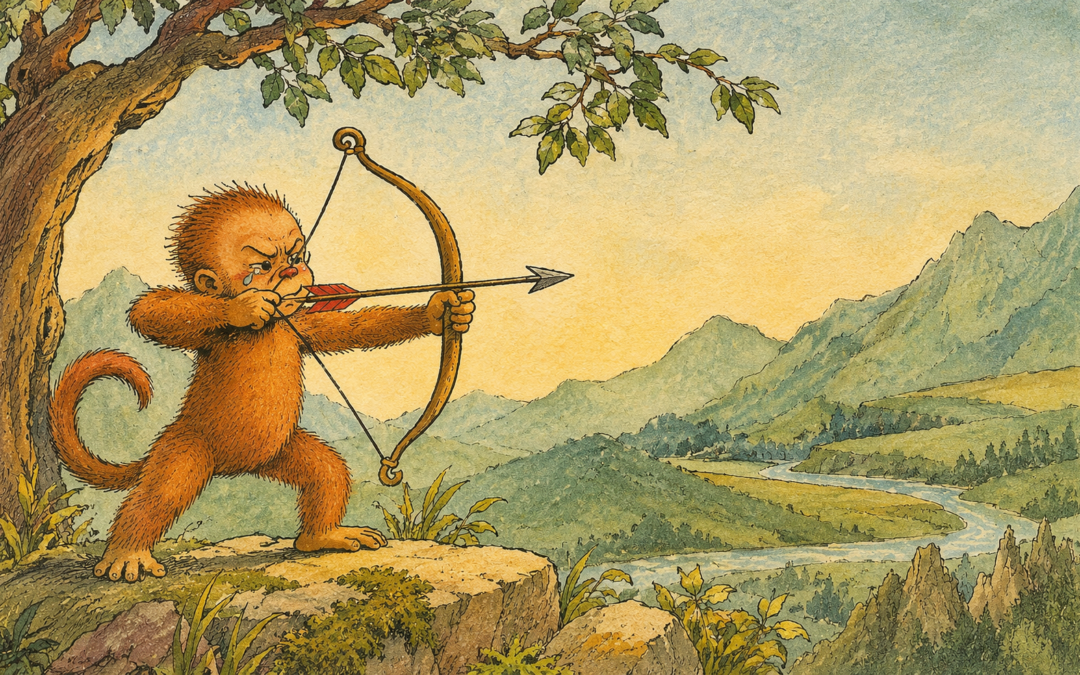
In the five-minute drive to school, I decided to drop some knowledge. I told him that when we’re hurting inside, it’s tempting to turn the hurt into arrows and shoot them at someone. Whenever he’s angry at everything and feeling all kinds of discomfort inside, I want him to have a good, safe place to let it out. I reminded him of a kids’ book we have with a “theater of hissy fits,” where the character builds marionettes and then smashes them to pieces. If he needs space to yell, to cry, to smash some pillows, I’m there to sit next to him, or to give him space to do it himself. But I’m not available for him to shoot those arrows at me or his mom, and definitely not at his teachers or other kids.
He seemed to be digesting it. Then he said he didn’t understand the difference.
I told him I knew how hard that was to get at seven, and that most adults don’t understand it either. Plenty of adults yell at people when they’re mad, or get into fights. Even some presidents start wars because they don’t know how to talk with each other. People really hurt each other because they don’t know how to feel the uncomfortable things inside and talk about them. Even his mama and I struggle sometimes, and when we do, we try to notice it quickly and apologize. We’re all working on it. It’s our job to help him learn it, and the more he and his friends learn it, the better his class, and eventually the whole world can be.
When we pulled into the school parking lot, his friend’s father was walking by, a dear friend of mine too, having just dropped off his son, and I waved him over to the window. I asked if he had any insight to share with my son.
“Wow,” he said, “that’s one I’ve really been working on, too, and so has my son. I think the difference for me is when I tell someone they’re the reason I feel bad, rather than telling them how bad I feel.”
My son said he didn’t understand that one either, though it resonated deeply for me. I told him again, “It’s a really hard lesson, and I’m here to help you learn it over and over. It’s okay to make mistakes. We all do. What matters is how we learn from them.”
That evening, around bedtime (another transition), my son was ignoring me as I tried to get him to clean up the toys strewn across the living room. This time I was the one who lost the thread, and I elevated my voice in frustration. My wife, now the one with greater poise, raised the wise hand at me that meant: go calm your ass down and let me take care of this.
That gave me a good pause, and I could see how the static frustration had built to a point where I no longer knew how to communicate while staying grounded and in my heart. We each have our points of tension where the vulnerability gets to be too much, and we shoot the arrow outward. We blame, we try to fix, anything to escape the reality of an unfixable moment.
Later, cuddled up with some books in bed, I apologized to my son and said that when I’d gotten upset at him, that was me shooting emotional arrows. I told him I’m still learning to say what’s needed without losing my cool.
He took in the apology and then said, “It’s okay that you got angry at me. The arrow didn’t stick. I think I get it.”
Now my son was teaching me. I tend to be a pretty contained parent, and it’s true I could probably let myself be messier, and a little more angry. Not that I should start yelling at him more, but that it’s okay to express emotions and then come back and repair.
So what am I trying to say? Emotions are a mess. After 20 years as a psychotherapist, writing books on mindfulness and emotional intelligence for kids, 30 years of meditation, and a lifetime of inner work, I’m still learning to fully be with the emotions that family stirs up. It’s so much easier to stay cool and wise with other people’s kids and issues. But our own family and our own attachment wounds are the unbearable part, and they lead us to judge, blame, fix, rage, shut down, whatever our armor of choice.
So of course it’s confusing for my seven-year-old. I need a real understanding of what he’s developmentally capable of. This is lifelong work we’re all doing together. He learns through my learning: through watching me be with my own vulnerability, notice my emotional habits, and actually change them. And I’ll keep catching him, again and again, when he’s shooting arrows or not being kind, and offering him ways to move his emotions or relax with them instead of inflicting them on others.
Here’s what I’m learning about not shooting arrows, and about modeling it for our kids.
1. Notice. First you have to become aware that you’re losing your shit. Ideally that happens before your partner has to hold up a hand, but awareness has to start somewhere. You might feel it as static tension rising in your body. Or you might notice your mind spinning in judgment about how your kid or spouse should be different. The tell is that you’re trying to change reality because you can’t bear how it feels.
2. Feel. Once you notice how desperately you need the moment to be different, turn inward. What’s so uncomfortable in there? Fear, anger, sadness, boiling, shutting down? Can you make some space for it and relax with it, without trying to fix it? Often it’s helplessness; parenting, and life in general, can be deeply disempowering. For me, it’s often the strain of holding a clear boundary while staying open hearted.
3. Respond. Feeling what’s actually there opens the door to being present. That morning, before I could help my son, I had to feel my own helplessness about not knowing how to get him out the door. Only then could I get down to his eye level and invite the cry he needed. His big feeling got held instead of turned into arrows.
4. Repair. And when you miss it, which you will, go back. That’s what I tried to do at bedtime. Maybe that’s the most important lesson of all: we all get into trouble, it’s how we get out that’s important.
I’m writing this for parents, and for anyone who gets triggered by the people they love. But I’m also writing it because so many of our public figures were clearly never taught the fine difference between feeling fully and inflicting our pain on others. Honestly, I think my seven-year-old already does it better than a lot of people we call adults.
So this is a prayer and a nudge for all of us to do the deep preschool work of learning that other people really exist and deserve our understanding and respect. The golden rule has been around forever because we keep breaking it and need to be reminded, with great kindness and patience, and with a steady insistence. Peace is an inner journey, and it’s one we have to take together. In our living rooms and on the world stage.