
With The Odyssey in theaters, audiences will once again meet one of mythology’s most important figures, a character our world sorely needs to learn from. Matt Damon, having played the epic action hero Jason Bourne and the wily con man in Ocean’s Eleven, now steps into the role of perhaps the most famous cunning hero of all time: Odysseus.
But Odysseus is not the character we want to focus on here. Hidden within the Odyssey is an ancient understanding that you won’t be shown in the IMAX blockbuster, and that you probably wouldn’t even notice from reading it.
The fulcrum of the Odyssey is not the Cyclops, nor the Sirens, nor even the return to Ithaca. It is the seven years he spends stranded on the island of Ogygia, where he is healed and loved by the goddess Calypso.
Played by Charlize Theron in Nolan’s film, Calypso is often portrayed as a temptress, another obstacle delaying Odysseus’s return. I think she is something far more important. Calypso is an apocalypse goddess.
I was drawn to Calypso’s shores well before the Odyssey IMAX movie. I had read the Odyssey, even partly in the ancient Greek, in college as a classics major. In the midst of working on a soon-to-be-released book on the mythologies, religions, and modern stories of crisis and apocalypse, I was once more drawn to her.
Apocalypse comes from the Greek apo-kalyptein. Apo means “away from.” Kalyptein means “to cover,” “to conceal,” “to veil.” The original Hebrew apocalypse prophets were called apocalyptic because they unveiled what had been hidden, revealing deeper truths through visions and prophecies. Calypso’s name comes from that same root. Without the prefix apo, she does not unveil. She veils. She covers. She is the goddess of concealment, of hidden things, of the fertile darkness where transformation unfolds.
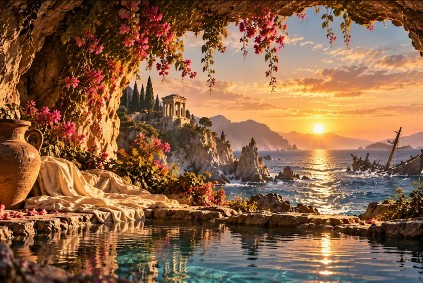
After all of Odysseus’s exploits, he blinds the Cyclops and proudly boasts of his victory. What he does not realize is that the Cyclops is the son of Poseidon, god of the crashing waves and unstoppable tides. Poseidon shatters Odysseus’s ship, sending his sailors to salty graves. Only Odysseus survives, clinging to a splintered plank, no longer carried by his own strength but by deeper currents. Those currents bring him to Ogygia, where Calypso draws his broken body from the sea and heals him in her sacred cave.
There, on the ever-spring island, the orchids and crocus bloomed, and the goddess took Odysseus to her bed as their lovemaking healed the wounds of years of war. By day he would weep upon the smoothed stone shore, and at night find the ecstatic embrace. Between grief and love, something inside him slowly softened.
If the Iliad is the outer bloom of heroic striving, the Odyssey is the necessity of loss, of death, of being remade. Calypso is a mythic figure, but she is also the natural cycle of biological and cosmic transformation. These ancient stories and archetypal figures have held fast all these millennia because they are truth-teachings about the essential cycles of our earth and cosmos.
Every cycle we know follows this rhythm. Suns are born and, after billions of years, burn out. Plants grow and die, dropping their seeds beneath the earth to sleep before being born again. Trees draw their life deep into their roots through the winter. Bears retreat to their dens. Every inhale ends in an exhale. Every day dissolves into darkness. Calypso governs this hidden passage between death and rebirth. She is the earth itself, receiving what has exhausted itself, covering it until new life can emerge.
We moderns have become deeply uncomfortable with this half of existence. We know how to strive, but we have forgotten how to descend. We have built a civilization that assumes endless growth is possible. Endless productivity. Endless stimulation. Endless striving. But that is not how nature works.
Our nervous systems were designed to alternate between activation and restoration. Yet many of us remain permanently activated, unable to return to the cave where healing naturally occurs. We live in chronic activation, our minds spinning, our attention scattered across screens, our bodies unable to settle. We burn ourselves out while, collectively, we burn the earth.
Odysseus needed to crash. He needed to be carried to the cave of healing. He needed to grieve. He needed to surrender the identity that had been forged through war. Can you feel that in your own body, in your own amped up life?
Odysseus remains on Ogygia for seven years. Why seven? The ancient apocalypse prophets offer a clue. In the Hebrew tradition, every seventh year the land itself was commanded to rest. Fields were left fallow. Debts were forgiven. The people stopped striving because the land itself required a sabbatical. This is where our word sabbatical comes from, a sabbath that lasted an entire year.
The prophet Isaiah warned that the people had broken their covenant with the land. Their temple had fallen. Their culture had been scattered. Famine and devastation had overtaken them because they had forgotten the rhythms that sustain life.
Apocalypse came when we broke our covenant with the land and with our own need to rest. Even thousands of years ago, people understood something we continue to forget. Left to ourselves, we keep working. We deplete the land as we deplete ourselves. Rest was not simply a pleasant idea. It had to become sacred law.
After years of external exploits, Odysseus needed an enforced rest. This wisdom appears in many traditions. Among several West African cultures, warriors returning from battle were considered too “hot” to reenter the village. They underwent rituals of cooling with water, clay, herbs, and incense before returning to their families. Ancient Israelite warriors remained outside the camp for seven days, ritually bathing before rejoining the community. Several Plains Indian traditions also required purification before warriors came home.
Only after his seven years on Ogygia does Calypso release him. She gives him a boat. She teaches him to navigate by the stars. She sends him home. The point was never to keep him hidden forever. The point was to remake him. By the time he reaches Ithaca, he is unrecognizably renewed.
Most of us cannot take a year-long sabbatical. We do not have a goddess waiting in a healing cave. Our culture is not designed to give us the space to truly slow down, to grieve, to release, and to be remade. It is designed to maximize output and keep us moving forward without pause. That is precisely the problem. We need to recreate a culture that remembers sacred pause, for ourselves and for the living systems that sustain us.
Rather than just celebrating heroes, we need to remember how true heroes are made. We can picture Jesus in the desert for forty days and forty nights, Buddha under the Bodhi tree, Odysseus for seven years weeping at the shore. The true hero, who is in service not just to external exploits, but to family, community, the larger world, must be cleansed of egoic pride and material striving. The hero needs Calypso, the apocalypse goddess, to humble us, to bring us down to the ground, to make us fall in love with this earth that we must serve.
We all need a good shipwreck now and then, and hopefully a loving space to rest and rejuvenate. Our earth heals and regenerates when just given time and space. Our nervous system just needs a lack of stimulation, and it naturally returns to rest. We need Calypso now more than ever, as the world speeds and heats. It’s not that we need to get rid of progress, technology, or growth. We just need to remember to keep returning to Calypso’s cave, slowing down, taking sacred rest. It’s hard to do in our modern frenzy, but either we willingly visit Calypso’s shores, or the storm will rock and wreck our ship of progress and enforce the pause upon us. It’s our choice, and Calypso is there to welcome us either way.
This essay draws from a chapter in my forthcoming book, The Gift of Apocalypse: 12 Myths for Courage in Crisis, published by HarperOne, where I explore twelve archetypes that help us navigate cycles of destruction and renewal.