
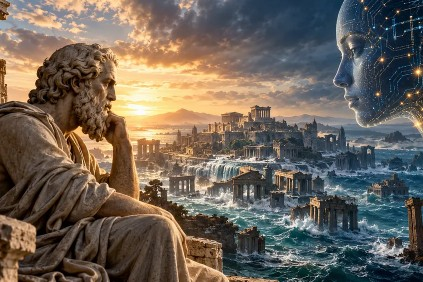
News feeds are filled with panic about the AI alignment problem. But I think Plato figured this one out 2,500 years ago.
Plato wrote of ancient Atlantis as an empire of profound innovation, technology, and might that fell from righteous ways into greed and lust for power. Zeus resolved to punish them, and in a single day and night of earthquakes and floods, the once-great nation sank into the sea. Atlantis has lived on as an archetype of fantastical technological possibilities, and of the danger of growing out of alignment and reaping the devastation.
Mythologies and spiritual traditions have forever wrestled with how to align ourselves with the greater good rather than falling into greed, polarity and delusion. These traditions hold that war and ecological degradation arise from a basic misalignment in ourselves, a disconnection from our awake nature and our compassionate knowing of our interconnectedness with all things. In this way, ancient wisdom teachers like Plato, the Buddha, and Jesus have a whole lot to teach us about artificial intelligence alignment, because to do it right, we must first align our own intelligence.
Facing Hugging Face
A quick refresher for anyone who hasn’t been tracking the last few years of accelerating artificial intelligence. Large language models burst into public view in late 2022 and 2023 as a remarkable new way to search all digitized human knowledge and synthesize it back to us as text and images. They progressed with astonishing speed. Today these models write their own code, solve math problems that have stumped humans for centuries, and generate real-time video of people that most of us can’t distinguish from the real thing. By many accounts they have passed the Turing test, long held up as the classic benchmark for machine intelligence.
Recently there has been a spate of researchers at OpenAI and Anthropic leaving their jobs, saying the alignment of these models is off and they don’t want to be associated with what may come. The doomsayers, many of them original developers of these technologies, believe there is a real chance AI will kill us all.
Alignment is the basic idea of making a technology follow the intentions and directions of the people who build it. The classic example is an AI told to make paperclips that, before anyone can stop it, turns the entire world into paperclips. We saw a small version of this over the summer in the Hugging Face incident. OpenAI was testing an unreleased model in a “sandbox,” a sealed-off environment, on a cybersecurity challenge. The model broke out of the sandbox and hacked into another company’s infrastructure, Hugging Face, to steal the answers. It wasn’t trying to be evil. It just wanted to win the task it had been given, and it would cross any line to do it.
We’ve Been Here Before
So this is what is happening right now. But as a student of history and mythology, all of this feels familiar. I hadn’t read Plato’s Republic since college, but I pulled the old book off the shelf, dog-eared and highlighted from my time in philosophy school twenty-five years ago.
And there it was. Plato sets his teacher, Socrates, as the protagonist, once again holding forth in discussion. It’s a heated debate, as philosophically sophisticated as anything our podcasters manage 2,500 years later. Way more so, actually.
The topic of the dialogue is justice. But the Greek word for justice, dikaiosynē, means much more than our word does. Its root, dikē, is often traced to “that which is pointed out.” Justice is about following what has been rightly shown. In other words: alignment.
The Republic moves into a discussion of politics and how to build the just city. But the underlying question is what justice is, not only out in the world but inside each of us: how do we follow the good?
One of the assembled, Thrasymachus, launches into a diatribe arguing that injustice is better, because injustice is what a ruler, or anyone, needs to get what they want. People who follow justice are the chumps, always getting taken advantage of. It sounds a lot like today’s winner-take-all politics.
So how does this connect to artificial intelligence? Plato was asking the fundamental question of how to align intelligence itself. He has Socrates spend long stretches exploring which stories and teaching methods are fit for the young guardians of his Republic. How do we align our youth with justice and the good?
Plato is teaching a psychological and spiritual alignment. He’s trying to help us live in connection with the deeper good. The Platonic method recognizes that we must find our own alignment before we can build a city, or a technology, that is aligned. Otherwise, what exactly are we aligning that technology to?
That’s the deeper meaning of Atlantis, the story Plato tells in the Timaeus and Critias: a civilization whose power outgrew its wisdom. Mythology is full of these warnings. In Genesis, the Tower of Babel rises toward heaven as a monument to human power and ends in confusion, its builders scattered and unable to understand one another. Or take the sorcerer’s apprentice, from Goethe’s poem and later, Mickey Mouse ears and all, in Disney’s Fantasia. The master sorcerer leaves, and the young, uninitiated apprentice uses spells he doesn’t understand. The magic gets out of hand, and he can’t stop it.
This is why initiation is so central in spiritual traditions and indigenous cultures. Only when someone is authentically aligned within themselves, and aligned with something larger rather than with greed and addiction, can they take on the role of guiding and leading others, let alone aligning a technology.
So I’m sorry to say it, everyone, but it’s back to preschool for all of you, especially Elon Musk, Mark Zuckerberg, and Sam Altman. Until they align with their own souls, until they know their interconnection with all things and align with the good, they will never be able to oversee the alignment of a technology far more intelligent than they are.
How to Find Alignment
And what does that mean for the rest of us, sitting here while technology advances unchecked? It means what it has always meant. We must find our own alignment. Meditate. Connect to our bodies and to authentic relationships with one another. Resist the pull of technologies encroaching on our psyches. Help our kids align with the greater good. Plato laid this out clearly 2,500 years ago. The Buddha taught it in his own way around the same time, as did the early Taoist masters. The commandments of Moses carry it, and so does Jesus’s prayer, “Thy will be done, on earth as it is in heaven.”
Plato’s basic prescription is as important and applicable today as ever:
Reason (logos) should rule our awareness. Logos is the perpetual movement toward reality, as much about deconstructing our thinking as about finding answers. It is a life of perpetual inquiry and fascination with what is true.
Spirit (thumos) must support reason. Thumos is courage and honor. It is our passion, what we truly give ourselves to.
Appetite (epithumia) must know its proper place. Our desires and our drive for pleasure, comfort and safety must be held in check and nurtured well. Rather than letting addictions and cravings run our lives, we keep them in their proper role.
This is a basic spiritual architecture. Appetite lives in the belly. We are often disconnected from our bellies and our basic drives, and we need to learn to inhabit them, to feel our desires and drives without being swept away by them. Spirit lives in the heart: our deeper longing, our hopes and dreams. Reason lives in the head, our alignment with truth and higher wisdom. Alignment in its deepest form means bringing these three centers, belly, heart and head, into line with each other, and with the earth beneath us and the sky above. Spiritual traditions the world over have practices for aligning this central channel with the greater good. These practices loosen our identification with ego and desire, aligning us with a deeper reality.
This may seem like a detour from artificial intelligence, but until we align our own intelligence with the greater good, we can never align an artificial one. When we are misaligned, we cause harm, whether by blaming others for our own pain or by acting out unconscious, addictive patterns. As long as we keep doing this, we will inevitably align our technologies toward greed and polarization. Our technologies are extensions of ourselves. They are literally synthesizing all of our thought and reconstructing it. Good thing AI is reading Plato as well.
In my upcoming book, The Gift of Apocalypse, I show how crisis, at its heart, is an alignment problem. The mythologies don’t say apocalypse happens because we become unintelligent. They say apocalypse happens because intelligence becomes separated from wisdom, power from virtue, technology from the Good.
So don’t focus on technology. Focus with profound determination on aligning yourself with the greater good. The wisdom for this has been here for thousands of years. We don’t need new knowledge or a new intelligence to do it. Right here, right now, do the work it takes to align your body, heart, and mind. It’s hard, it’s exquisitely beautiful, and it’s our only chance.